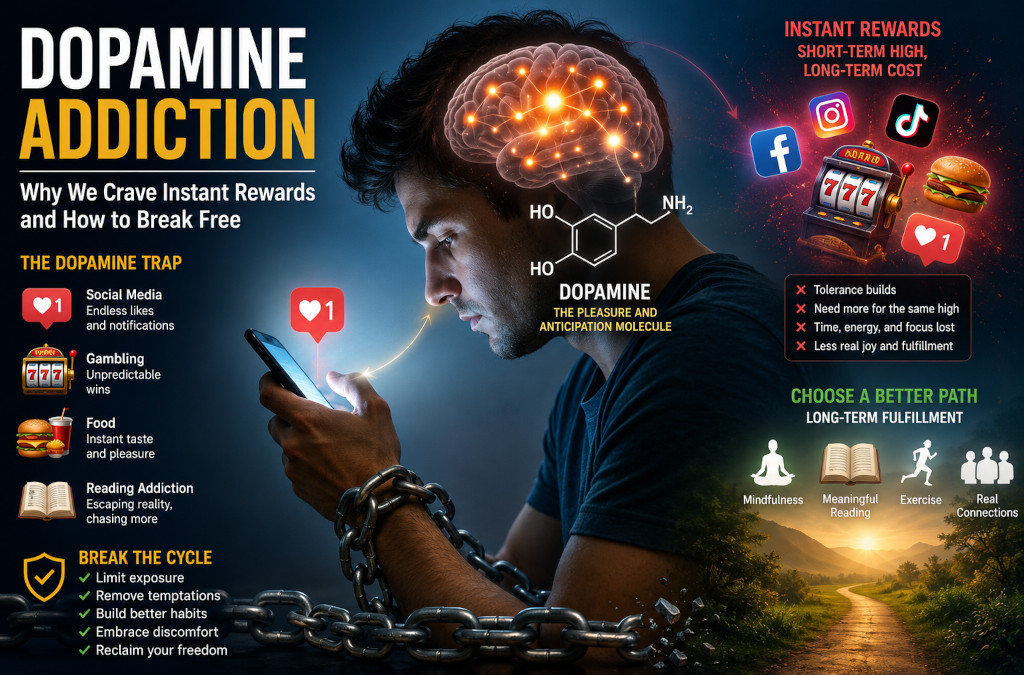
You may have heard about dopamine. It is the pleasure molecule, or more correctly, the anticipation molecule. Without dopamine, you would die.
Dopamine is driving us to achieve. It is the internal chemical motivator. Research showed that mice that are genetically engineered not to produce dopamine will not search for food and will die of starvation. If you put the food in their mouth, they will eat it. It is the drive they lost, not the appetite.
Dopamine makes us addicts. It gets released when we satisfy our cravings. And we want more of it. Due to neuroadaptation, our body gets accustomed to whatever drug we are taking, and we need to increase the dosage or frequency to get the same level of pleasure. The same dosage doesn’t cut it anymore. And thus, the wheel of addiction starts turning.
What’s worse, we can eventually get to the point where no amount of the drug works. We can’t get the level of pleasure we used to. The initial hunt for pleasure leads us to the inability to experience pleasure at all. The good news is that our brain is pretty elastic and usually adapts. If we abstain long enough from the drug, the brain resets to its original levels, and we can experience pleasure again. However, the journey can be tough.
When it comes to gambling or the use of social media, it is the unpredictability of the outcomes that drives the addiction. When the chance of winning or losing is equal, we experience the highest increase in dopamine levels. It is when the game is most exciting. The same goes for social media. We post something and then eagerly await the number of likes we receive. It is unpredictable. It is exciting. And it is addictive.
Addiction To Reading
While historically, people would get their dopamine from food, drugs, or gambling, nowadays, it is getting easier and easier, and the most frequent dopamine shots come from our smartphones. It is all the social media posts and likes that come in an endless stream, twenty-four hours a day, seven days a week. It is always there, and it is difficult to resist. It has become our drug of choice.
It took me a long time to figure out I was addicted too. Addicted to reading. I have always loved reading, but during the COVID-19 pandemic, I was reading more than a hundred books a year. What’s worse, many of them for the second or third time. Reading has become not only a way to improve my knowledge of the world, but also a way to escape from it. I would often skim through the boring passages, looking for the action and thrills to get my dose of dopamine. And it wasn’t just thrillers, detective stories, spy novels, or sci-fi. Even self-help books, leadership, and psychology books have the same effect.
Some books are unputdownable. For me, that is pretty much every book. Even the bad ones. When did my bookwormishness become an obsession? When I got my first Kindle e-book reader. Now, I had the books at my disposal wherever I went, and when I finished one, I immediately started another. When the drug is easy to get and available to you all the time, it is much more likely you will try it, and you will get hooked.
Reading is a great hobby, but when taken to the extreme, it can negatively impact the rest of your life. The day has only twenty-four hours, so the time you spend reading is time you don’t spend doing other things. Fortunately, I’ve gotten over my book addiction. Even though I’m still a strong proponent of reading and read about fifty books a year. I believe it is one of the best ways to relax and gain knowledge. However, as with everything, I would caution against overdoing it.
Evolution And Technology Work On Different Schedules
The evolution takes time. The technological advances are not so significant. We are changing the world around us faster than our biology can adapt; therefore, while we have evolved to live in a world of scarcity, we now live in a world of abundance. For the most part, we don’t worry about starving to death. On the contrary, we should worry about overeating and obesity. We work hard to avoid any pain and feel pleasure as much of the time as possible. And that makes us weak. We are seeking pleasure and dopamine-fueled rewards, and that makes us addicted to tons of unhealthy activities and things.
When you realize you are addicted to dopamine-fueled behavior, you may consider stopping. But be aware that withdrawal may be painful, and in fact, it may drive you to try another activity that will get you the dopamine high.
Often, our unhealthy dopamine-driven behavior is caused by the need to escape our thoughts or boredom. You need to accept that being with your own thoughts and emotions might be uncomfortable, and you will need to get used to it. If you keep trying to escape them, you will keep seeking other activities that will trigger the release of another dopamine dose.
Things that help you stay in the moment, such as mindfulness exercises, can also aid in this process. Of course, you can’t rely solely on your will, so be sure to remove temptations from your environment. If you can’t reach your smartphone, or you don’t have access to the internet, you won’t get addicted to spending every waking moment on social media trying to get a shot of dopamine.
Limiting Supply Of Drug To Fight Addiction
Limiting the supply of drugs is the one way that has been proven to fight addiction. The more available the drug is, the easier it is to get access to it, and the more likely people will try it repeatedly until they develop an addiction. If the drug is not available, then no addiction is possible. Even something like alcohol abuse can be mitigated this way.
The Prohibition in the United States from 1920 to 1933 led to a decrease in the number of people drinking alcohol and getting addicted to it, and it was reflected in the decrease in public drunkenness and related health issues. It had unintended consequences in the creation of the black market and gang violence, and a negative impact on the economy as it wiped out a whole industry, but looking purely at the addiction level, it worked. When it ended, and the alcohol became more available, the percentage of Americans who had alcohol issues steadily grew.
We live in a world of abundance, and a steady supply of drugs leads to the development of demand. There is nowhere to hide from oversupply, and it leads to overuse. We are powerless to fight it.
As Anna Lembke notes in Dopamine Nation, “Today’s cannabis is five to ten times more potent than the cannabis of the 1960s and is available in cookies, cakes, brownies, gummy bears… the list is endless.” Higher potency and wide availability equal higher levels of addiction. That’s simple math and human nature.
This is visible not only in what we generally consider drugs but also in things like “normal” food that has become addictive. Take potatoes, for example. Highly nutritious and generally healthy food. If you eat it boiled without any other processing.
The 2023 Annual Potato Yearbook, published by the National Potato Council, claims that potatoes are the number one vegetable consumed by Americans. Yet only 26% are fresh. The whole 39% are frozen (French fries), 22% are in the form of potato chips, and the rest are in other forms. Clearly, a majority is highly processed, salty, and oily. With these additives, the potatoes are no longer healthy; they have become addictive, and not to mention, they pack significantly more calories.
Then comes the Internet, which consistently promotes overconsumption. It gives you easy access to ordering addictive food, watching addictive videos, and showing us all the ways to mess up our lives that we wouldn’t have thought about without it. And we follow. When we see many others doing something, we start looking at it as “normal behavior.” We get seduced and eventually addicted.
Putting Barriers In Place To Fight Addiction
Establishing the proper barriers requires doing so while still retaining some free will. Once you are under the spell of desire and compulsion, it is too late. At that point, your will won’t be enough to keep you away from the drug, be it an abusive substance or unhealthy behavior. If you overeat, the barrier can make it difficult to access unhealthy snacks, so consider throwing away anything you can snack on.
If you are addicted to the internet, consider a way to limit your access to it technologically. Consider installing an automated power switch that cuts the power at a specified time, or even cancel your internet connection at home if you don’t need it for work.
In Dopamine Nation, Anna Lembke suggests that there are three categories of this form of “self-binding.” Physical strategies involve adapting the space, chronological strategies limit the time spent on bad behavior, and categorical strategies address the underlying meaning.
Physical strategies work great for things where your addiction gets triggered in a specific space, like at home. You have the environment completely under your control, so you can tweak it in a way that prevents you from doing things you are trying to avoid. Are you watching too much TV? Get rid of it. Are you constantly snacking on chocolate? Throw it away. Can’t you resist alcohol? Remove it from your house.
Chronological strategies then limit the time you can spend on a particular activity. For example, you may choose to limit your social media use to only the weekends. Or you can decide never to switch on the TV before 7 pm. Ideally, you want to put physical barriers in place, such as placing the remote in a difficult-to-reach location, so you can’t just mindlessly click it the moment you get home and realize you need to wait until the selected time.
Even tracking the time spent on an activity can make it visible to you how much time you are wasting on it, and can help you cut it down meaningfully. At least, it makes it clear to you that you’ve got a problem, and you can deploy other strategies to deal with it.
Limiting categories of food to eat is a classic example of self-binding. Whatever the diet you decide to follow, vegan, raw, vegetarian, ketogenic, Paleo, and many others, what you are doing is limiting the pool of food you have access to. Not only do you limit the consumption of certain ingredients, but by limiting what you can eat, you are making it more difficult for you to overeat in the first place.
Until the market catches up with the latest diet fad. The moment businesses start to see a specific diet movement gain popularity, it becomes a lucrative business opportunity, so suddenly, there is a plethora of food options that cater to the specific diet. A gluten-free diet would be a great example. While originally it was meant for people with Celiac disease who can’t process gluten, it quickly became a diet many other healthy people follow. The industry has responded, and today, you can find a wide variety of gluten-free products.
In the curious turn of events, once you limit your options and prevent yourself from being addicted, you become free. Introducing constraints and discipline to your life can lead to greater freedom. Who would have thought?
Putting It All Together
The dopamine-driven world we live in today presents us with a fundamental paradox: while technology has given us unprecedented access to information, entertainment, and instant gratification, it has also created new forms of addiction that can quietly hijack our lives. From the endless scroll of social media to the compulsive consumption of books, podcasts, or processed foods, we find ourselves trapped in cycles of seeking the next dopamine hit.
Our ancient brains, evolved for scarcity, are not equipped to handle the abundance of modern life. What once helped our ancestors survive now works against us in a world where every craving can be instantly satisfied with a few taps on a screen.
When we realize that our compulsive behaviors are driven by dopamine rather than genuine choice, we can begin to reclaim control. The strategies of self-binding, whether physical, chronological, or categorical, offer practical pathways to break free from these cycles.
Constraints create freedom. By deliberately limiting our options, removing temptations from our environment, and building barriers between ourselves and our addictive behaviors, we paradoxically gain more genuine choice in how we spend our time and attention.
Photo: Generated with Dall-E


Leave a Reply