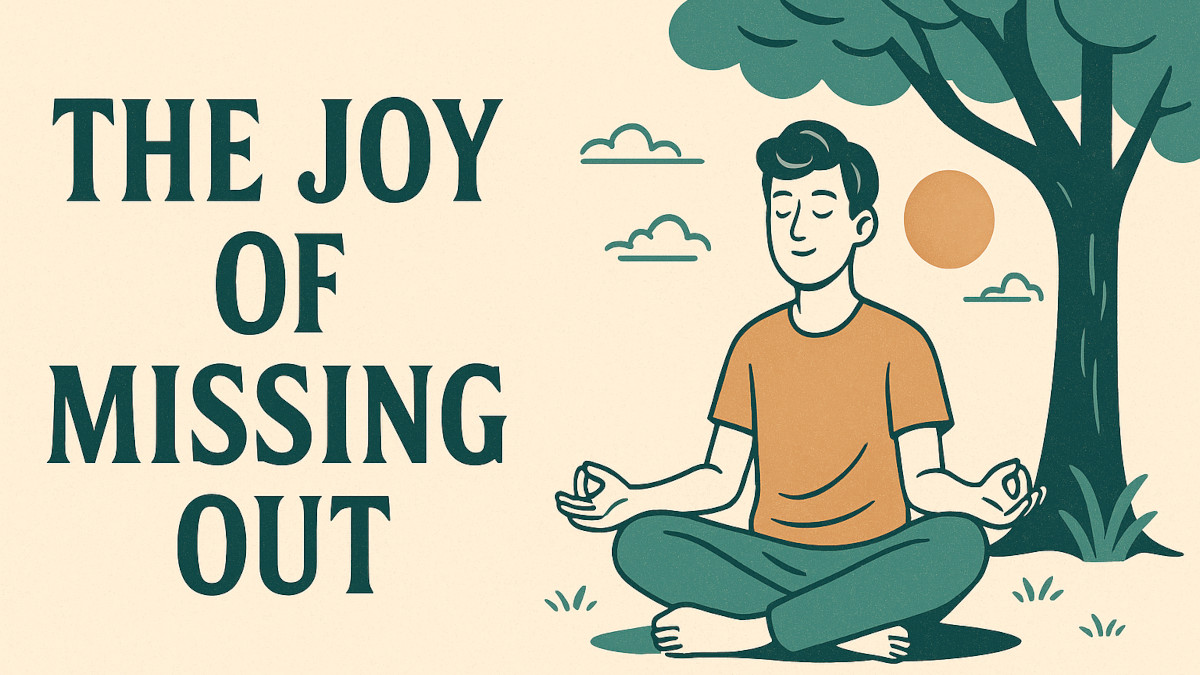
The word “instant” feels efficient. But is it? It leads to diminishing actual experiences. Welcome to the world of JOMO (Joy Of Missing Out).
You may find it efficient to order food online instead of going to a restaurant, but then you’re missing out on the part of the experience that makes eating out enjoyable. By trying to be more efficient, you may increase the number of things you can do. Still, you will often decrease the quality of these experiences.
By going the more convenient road, you lower the quality of your life. It might be more convenient to watch a movie at home on your favorite streaming service, but it would be more valuable and enjoyable to go with a bunch of friends to see the same movie in a cinema. What is convenient is not automatically better. Even convenience has a dark side.
Being In The Present
Being in the present is, in the end, the only way of being. Take it one minute at a time. You can still plan the general direction you want your life to go, but you shouldn’t wait to get there before you start living. Set the direction for your future, then let it go and focus on the present.
Social media then makes this even more difficult, as we are constantly tempted by pictures of our friends and acquaintances doing things, living life to the fullest, and having a great time. No matter if it is all artificial, and they are most likely as miserable as we are. You may have ten friends, each attending a different event or activity and posting about it on social networks. Now you know you are missing out on ten things. Even if you manage to attend one or two, you will still feel miserable.
Impatience As A Way To Misery
One of the easiest ways to become unhappy is to nurture impatience. Due to the rapid pace of progress in our society and the fast way of living, we are becoming increasingly impatient. Everything needs to be done instantly. If something doesn’t meet our immediate needs, we become impatient and angry.
We are stuck in a traffic jam, so we start honking and cursing at the other drivers who are in the same position. As if that would make the traffic jam disappear.
We want to learn something new, so we pick up a book and then put it down quickly when we discover it would take us a couple of weeks to read and learn from it.
We want a great career, but we quit the company after a year when we realize it would take two more years to be really good at our job to deserve the promotion, so we try to game the system by joining a company that is more desperate and gives us the title and position we are ill-equipped to handle.
We are hungry, but cooking a meal would take a couple of hours, so we grab an instant meal even though it is of lesser quality.
Changing The World Requires Acceptance And Patience
We are trying very hard to make the world behave in the way we want it to. And it doesn’t. It can’t. The laws of physics can’t be broken. No matter what you try to do, some things simply can’t be rushed or changed. The only way to fight the frustration we then experience is to accept things for what they are. Some things are not in our power to change. Accept it. And focus on things you can change. You are responsible for your own feelings. Being frustrated with the fact that a day has only twenty-four hours, while you obviously can’t change it, is ridiculous.
I’m a bookworm. I’m an avid reader. And that is one thing that I struggle with greatly. There are so many books I would love to read. Hundreds of thousands of books are published each year by traditional publishers. Add those that are self-published, and you get to millions. I read between fifty to a hundred books a year, and I’m unhappy about the number. I have a long list of books I want to read.
So I try to read faster and faster, and the quality of the experience suffers as a result. What’s worse, I catch myself occasionally having a really hard time focusing on what I read. My mind would wander, I would get distracted by my phone, or I would feel the need to listen to the radio while reading. The outcome is pretty clear. I significantly diminish both experiences. In short, I’m trying to speed up things that can’t be sped up. The brain needs time to process the information it receives, and it needs to focus.
With all the distractions and the speed of today’s life, it is more and more difficult to focus on individual words and sentences. We don’t have the patience. The reading is increasingly about skimming the text, trying to catch some interesting word or piece of information. If nothing catches the eye, we skip the paragraph or a page. We finished the book faster, but we have no clue what it was about. It is so much easier to put down the book and just read a couple of messages on Twitter or similar media. We’ve got 140 characters. Not 140 pages. Much easier to stay focused and much more satisfying in the moment.
I would still pick up the book and read every minute of my spare time, but the quality of the reading is visibly different during the busy week when my mind is preoccupied, and during the weekend or on vacation, when I can spend hours of undivided attention reading something I enjoy.
Accepting the world as it is and cultivating patience can have a profoundly positive impact on your well-being and mental health.
Yes, being patient doesn’t seem particularly cool, as it sounds like a rather passive virtue. If you patiently let other people abuse you, it will never end. If you patiently wait for your promotion, it may never happen. In this type of situation, patience and passivity are essentially making you a victim. You are accepting your inability to do anything about your misfortunes.
But there is the thing. Being patient with things you can easily change or influence will hold you back. Be patient with things you don’t have under your control. And be proactive with things you can influence.
Yes, you can’t change whether someone tries to abuse you, but you can confront them or walk away. You can’t make your boss promote you, but you can approach them and clearly state your expectation and ask for what you need to do to get the promotion.
“Cultivating patience in the right context can improve the quality of your experiences greatly.“
In Four Thousand Weeks, Oliver Burkeman talks about a lesson he learned from Jennifer Roberts, who teaches art history. She would ask her students to visit a local museum, select a painting, and then examine it for three hours. No checking the phone. No conversation with others. No food. Just staring at the painting.
Three hours is a very long time to watch just one piece of art. You get bored after five minutes. Your mind will wander. But eventually, you run out of topics to think about, and you start paying attention to the painting again. You start seeing the details. You see things you missed when you first saw the painting. You start thinking about what led the artist to create it. What is in the scene, and what could precede or follow it? You get a completely different level of experience. Much richer. You finally truly see the art for what it is. Surprisingly, you also get more comfortable with the idea of sitting in front of the painting and just enjoying it.
You started inpatient, went through a period of anxiety and boredom, but ultimately got comfortable with just being here and now, not trying to rush anything.
To cultivate patience, you need to be comfortable with having unsolved problems. It is often our need to fix things, get things done, and have things perfect that drives our impatience. Getting comfortable with the idea that not everything in life is perfect will help you become more patient. Then it is the idea that nothing needs to be done instantly. You can work on things step by step. When you set out to perform an activity for two hours, then stop after two hours. Even if you feel you could go on, there is no need. It may just lead you to overdo it today and be too tired to continue tomorrow. Consistency and a step-by-step approach are much more powerful and sustainable.
Patience and commitment go hand in hand. You may set out to learn to play piano, but without patience, you won’t get far. Yes, the first couple of months will yield little progress. If you are impatient, you may choose to quit and start learning to play guitar instead. And the same thing happens.
After a couple of years, you started to play a couple of different instruments, but because of your impatience, you couldn’t play any of them. If you stay with the piano for the same amount of time, you will be able to play decently after a couple of years. Committing to a path and patiently staying on it, even when it gets difficult, will ultimately yield the results you want. Perhaps it will take longer than expected, but that’s fine. You will learn to enjoy the journey.
We All Work On A Different Schedule
We often claim and are unhappy about not having enough time for our friends or family. The work seems to spread into every free minute of our time. Yet, often it is not that we wouldn’t have time. It is that we work on a different schedule from the others.
Consider a group of your closest friends. You’d like to grab a coffee or go out for dinner. It may be quite a challenge to find a time that would work for everyone. Especially if each of you has a different job and a family. You may end up scheduling coffee several weeks ahead, and still, not everyone shows up. Each individually, you would have time to grab a coffee, but not at the same time as others. You have freedom, but somehow this freedom doesn’t allow you to meet with your friends.
We work within our own schedule, and it costs us the freedom to interact with others the way we would like. The implication is also very real for society at large, as we are each living in our own bubble, which allows the rise of non-democratic totalitarian regimes that thrive in places where individuals don’t bond over common causes. All that is needed is for each individual to support the ruler. Any grassroots initiatives where people align their calendars and work towards a common cause are discouraged.
Joy Of Missing Out
In The Joy of Missing Out, Svend Brinkmann presents an alternative to FOMO (fear of missing out) that she calls JOMO (as you guessed, the joy of missing out). It is not only accepting that we can’t do and have everything, but it teaches us to embrace and even enjoy it.
There is beauty in simplicity. Less is sometimes more. Embracing JOMO will help you alleviate the frustrations and anxiety that come from the endless pursuit of more. It will make your life more satisfying.
Forget about “instant.” Consider the idea of the joy of missing out. Replace the fear of missing out with the realization that focusing on a limited number of things and committing to them will make them more meaningful. Don’t try to keep all the doors open. Pick one and close the others. This means that it is fine to procrastinate as long as you procrastinate on the right things. Do the important, neglect the rest.
Of course, the problem is when everything feels important. When you have more important things than you can fit into your day, that’s when it feels like efficiency could help. The alternative is to redefine what is important. Perhaps your “importance threshold” is too low, and you need to reconsider what is truly important and what is merely tempting, but ultimately unnecessary. Be comfortable with missing out.
Being comfortable with missing out on things means you need to get comfortable with moderation. You need to abandon the endless pursuit of more. You need to accept you can’t have it all. If you keep all your options open and try to do it all, you can’t get good at anything specific. You may even get seduced into unethical, immoral, or illegal behavior in your pursuit of more.
By employing moderation and self-control, you can focus on the important things, and you can flourish.
Photo: Generated with Dall-E



Leave a Reply