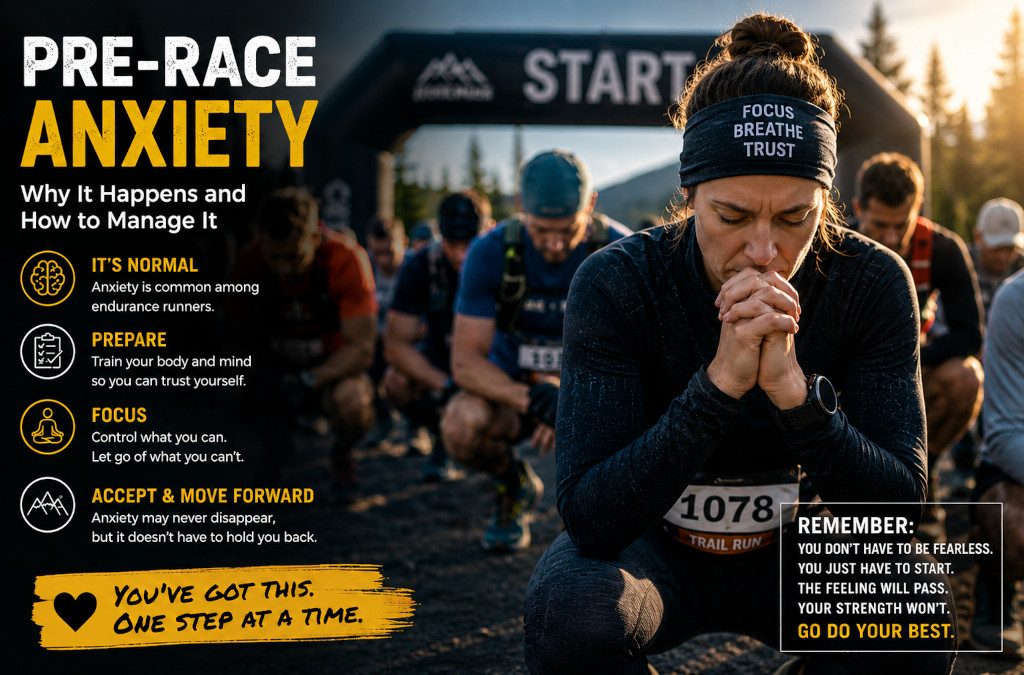
Pre-race anxiety. When I ask around, I hear many people feel anxious before the race. “Am I ready?” “What is the race course going to be like?” “What about the weather? I really don’t want it to rain.” “What about the competition? Will I do well?” “Will I be able to finish? I really don’t want to have the letters DNF next to my name in the results.” And so on. Many people worry before the race for many different reasons.
In fact, a study from 2025 showed that anxiety and sleep problems are common in endurance runners. From the 601 participates of the study, 13.5% screened positive for anxiety and 28.8% for sleep problems. Interestingly, this manifested more among half marathon runners (25.2% anxious and 38% with sleep problems) than among marathon and ultramarathon runners, where only 8.5% and 11.1%, respectively, were anxious. One could conclude that the more experienced you get and therefore the longer distances you are able to run, the less likely it is that you experience pre-race anxiety.
Mental health issues, such as anxiety and sleep problems, are common in endurance and ultra-endurance runners, and positive screening for anxiety co-existed and was associated with positive screening for sleep problems.
I speak from my own experience. I often feel that I should have trained more. At the same time, since I’m pushing myself to participate in increasingly difficult races, I genuinely don’t know what to expect from the race or from myself.
My first ever OCR race, or in fact any race, was Spartan Sprint. It is a meager 5+ kilometers with 20 obstacles to tackle. It had been raining the day before, and the course was wet and muddy. I didn’t train specifically for OCR, and I wasn’t even sure I could run 5 kilometers since it was on hilly terrain. I wasn’t sure I could finish. I did. I learned quite a bit. I realized I need to train more. But I also got a bit more self-confidence. I knew I could do this type of race.
Next time it was Spartan Super, which is 10+ kilometers and 25 obstacles. Then it was these two races in one day. Then it was Spartan Beast, with 21+ kilometers and 30 obstacles. In two years, it was Spartan Trifecta Weekend, with all three races in one weekend.
The latest was Spartan Ultra Trail, a 52-kilometer race without obstacles. Each time I worried before the race. Mostly about my ability to finish, as I’m not really having any ambitions to actually race. I just want to finish and push myself a bit forward so I can do more and better next time.
Yet, when standing at the start line, I feel anxious. I feel like having no energy. My legs feel heavy. Even my heart rate is higher than it should be, since no effort has been made yet. It is not debilitating anxiety, but it is not a good feeling. Pity. What’s worse, it takes me a couple of kilometers to actually completely calm down and focus on running. Then I start enjoying it. In my latest run, it took me about 6 or 7 kilometers to get to a comfortable state where I started to enjoy the run and got into a good rhythm.
And it is not just enjoyment of the run that is at stake here. A study from 2025 specifically focused on trail runners showed that those with high precompetitive anxiety, mental fatigue, and poor sleep quality have a higher risk of running-related injuries. Yes, when you’re too anxious, you increase your risk of injury during the race.
Another study showed that significant psychosocial stress can increase lactate levels in your bloodstream, even without actual physical exercise. You are getting tired even before you even start the run.
What Can You Do About Pre-Race Anxiety?
But what can you realistically do to feel better before the race? One thing. Prepare. Prepare yourself physically but also mentally. You need to train in a way that prepares your body for the challenge and convinces your mind that you are ready.
Especially for older runners, one needs to realize that our bodies are simply different from when we were 20. When listening to others’ advice, keep that in mind. If you are close to 50, like me, you don’t want to follow a training plan for someone in their twenties.
What I find important is to set a realistic training plan that you will feel good about. You need to believe that the way you train will actually prepare you. If you then follow the set plan, you will feel better on the day of the race. You will know that you did what you needed to do to be ready. It will automatically increase your self-confidence and lower your anxiety.
A realistic training plan also has the benefit of creating a system and ultimately a habit around running that will get you closer to your goal than relying on willpower. For more information on building habits, check out my book DAILY: Becoming the Best Version of Yourself Day by Day.
And then there are various mental exercises you can run through, starting with meditation, mindfulness, or positive self-talk. Ideally, you want to learn and practice these during your training and don’t leave it just for race day. It pays off to shift your mindset from “I want to win,” to “I want to do my best.” The problem with “I want to win” is that it creates undue pressure. And not only the winning part.
The moment you set yourself a goal to win a race, you automatically create stress for yourself, because there are way too many things you have no control over. What if all the other participants are genuinely better? You will finish last regardless of your training. That’s why my goals are always related to my own performance rather than to things I can’t control. I want to finish. I want to do better than I did the last time. I want to do my best. If, as a consequence, I beat some competition, great, but I don’t worry about that part.
Putting It All Together
In the end, pre-race anxiety is not a sign that something is wrong. It just shows that you care, are committed, and are willing to give it a try.
What experience, research, and miles on the trail all suggest is that anxiety doesn’t disappear entirely. It evolves. With preparation, it becomes less prominent. With experience, it becomes familiar. And with the right mindset, it can even become a useful signal that your body is gearing up for something meaningful.
Even with proper preparation, you may never feel completely calm at the start line. Your legs may still feel heavy, and your heart rate may be a bit too high. But you’ll also know that you’ve done the work, that you’ve faced this feeling before, and that it fades once you begin.
So don’t aim to eliminate pre-race anxiety. Learn to recognize it, accept it, and move forward anyway.
Photo: Generated with Dall-E



Leave a Reply