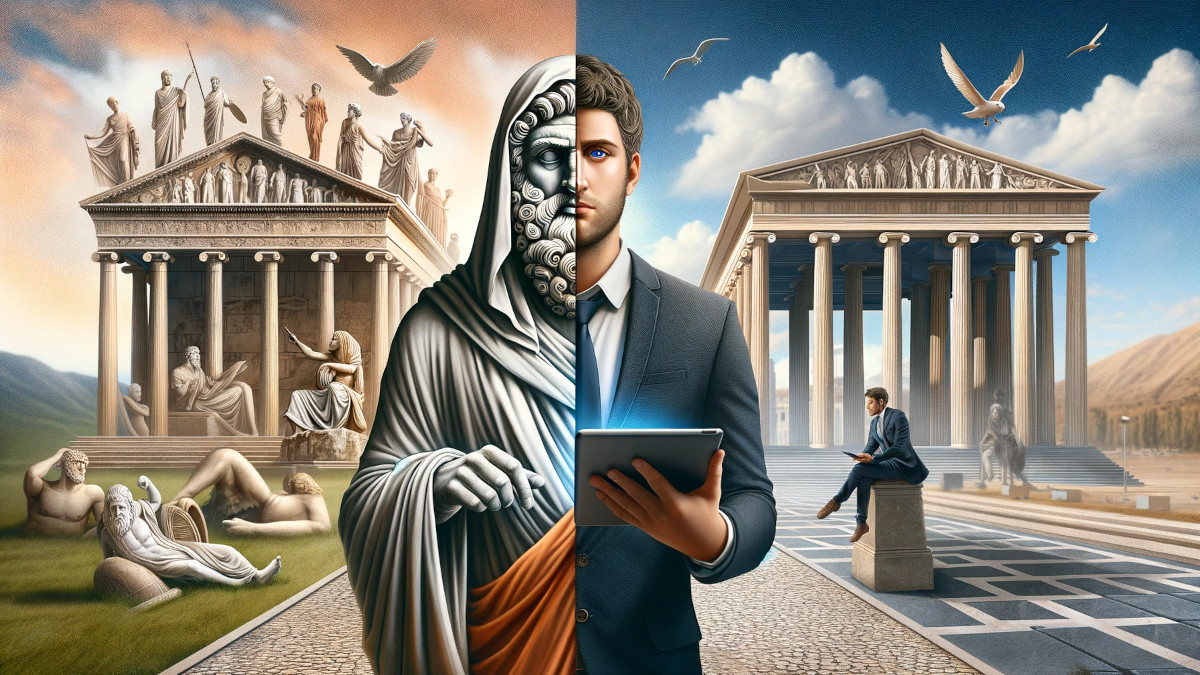
Over the past several years, Stoicism has experienced a resurgence as a practical philosophy for the 21st century.
Its focus on ethics, physics (which can be understood as a combination of metaphysics and natural science in modern terms), logic (which today would be called cognitive science and philosophy of language), and the belief that everyone can achieve eudaimonia (or happiness and flourishing) through the practice of virtue, which is within one’s control, continues to be very appealing.
As Donald Robertson summarizes in Stoicism and the Art of Happiness, the Stoics proposed that the goal of life is to live in harmony with the nature of the universe and to excel as rational and social beings.
The relevance of Stoicism in the 21st century
In How to Be a Stoic, Massimo Pigliucci writes that Stoicism is often misunderstood. The word “stoic” has an unfortunate meaning in English, typically referring to a person who can endure hardship without showing emotions. This is a misunderstanding of what the original Stoics meant. Stoicism is not about suppressing emotions but acknowledging and reflecting on them and then redirecting them for our own good. It is about understanding what is within our control and focusing our attention and efforts on things we can influence while ignoring those we can’t. It is about practicing virtue and excellence, continuously improving ourselves, and finding satisfaction in the lives we have.
“Stoicism is not about suppressing emotions but acknowledging and reflecting on them and then redirecting them for our own good.”
I appreciate the approach taken by William Irvine in A Guide to the Good Life. Irvine suggests a slightly different perspective on the work of ancient philosophers. While they focused on virtue, Irvine argues that tranquility is more relevant to the 21st century.
However, Donald Robertson counters this argument in Stoicism and the Art of Happiness by reflecting on what the ancient Stoics would say about tranquility. Tranquility by itself does not lead anywhere and should not be the ultimate goal in life; it is simply a pleasant byproduct. If it were the ultimate goal, one could hide in a forest, take tranquilizers, and be happy forever. We can likely agree that this alone is not enough.
Nevertheless, we should not completely disregard tranquility. I believe it is an essential byproduct that we all desire in our lives.
One aspect that sets Stoicism apart from other philosophies is its practicality. It is not meant for endless academic discussions; it is meant to be lived. It provides guidelines for a meaningful and happy life. As Xenophon, the Greek philosopher, historian, soldier, and student of Socrates, believed, the same applies to our character as it does to our body. If we do not exercise our bodies physically, they will become weak. Similarly, we will become morally weak if we do not exercise our character.
“Stoicism is set apart from other philosophies by its practicality. It is not meant for endless academic discussions; it is meant to be lived.”
Due to its practical focus, Stoicism has become the foundation for several evidence-based psychological therapies, such as Viktor Frankl’s logotherapy and Albert Ellis’s rational emotive behavior therapy. Both Albert Ellis, the founder of Rational Emotive Behavior Therapy (REBT), and Aaron Beck, the founder of Cognitive Behavioral Therapy (CBT), mention Stoicism as their main philosophical inspiration for their therapeutic approaches. A famous quote by Epictetus serves as a basis for explaining the framework of CBT theory: “It’s not the accident that distresses a person, but rather the judgment they make about it.”
Viktor Frankl, while imprisoned in concentration camps during World War II, drew upon the thoughts of ancient Stoics. After his release, he developed what he called logotherapy, heavily influenced by Stoicism. If you haven’t read his excellent work Man’s Search for Meaning, I suggest you give it a go, as it is one of the most eye-opening and chilling books on topics of meaning, happiness, and suffering.
Another aspect of Stoicism that sets it apart from other philosophies of its time and makes it relatable today is its genuinely democratic and inclusive nature. It does not require adherence to a specific gender, class, or religion. It is not contingent upon personal worth, social status, health, or education. None of these factors determine whether one can live a virtuous life. All that is needed is the cultivation of character and the practice of virtues.
As a nonreligious person, I find the Stoic philosophy immensely practical, as it is grounded in ethics and humanism. It also shares similarities with religions such as Buddhism, Taoism, and Christianity. This universal nature of Stoicism makes it appealing to those who see themselves as citizens of the world rather than belonging to a particular country or city.
Adaptations of Stoicism for the modern world
One significant challenge modern Stoics encounter when examining this two-thousand-year-old philosophy is its dogma of living in alignment with nature. The ancient Stoics believed that nature is inherently good and organized for a purpose. Thus, living in accordance with nature seems reasonable. However, with modern scientific knowledge, this becomes harder to accept, as we now know that the universe is chaotic and indifferent to us mere mortals.
A more suitable interpretation of the “living in accordance with nature” principle in modern Stoicism could be described as following the evidence before drawing conclusions. This allows us to explore the natural sciences, understand the physics of the universe, and utilize them as guiding principles in our lives.
Facts matter greatly, especially considering the concerning trend toward a future where facts seem to hold less importance. People often mindlessly follow what they read on social media and fail to engage in critical thinking when listening to populist leaders. Just think about how frequently we hear the term “fake news.” By neglecting the pursuit of truth, we are not living in harmony with the purpose nature intended for beings capable of reason.
Another adaptation in modern Stoicism is the consideration of varying degrees of virtue. The ancient philosophers believed that one is either virtuous or not; there is no middle ground. This black-and-white perspective no longer aligns with our understanding of the world. It was even controversial in ancient Rome. A more effective approach to virtue is recognizing that there is always room for improvement, and the mere effort to strive for it is something to be valued. There is no need to obsess over whether one has achieved sagehood or not; it is still possible to live a fulfilling life.
Modern Stoics also question the concept of the dichotomy of control, which states that something either falls entirely under our control or not at all. This notion seems overly restrictive and impractical for everyday life. In A Guide to the Good Life, William Irvine suggests that we should be comfortable accepting that some things are partially within our control. We should do our best with what we can control and avoid becoming too attached to what lies beyond our influence. It may also be helpful to reframe our goals in a way that focuses solely on what we have complete control over.
What next?
If you still believe that Stoicism is solely an ancient philosophy, consider who practices Stoicism today. The Daily Stoic website provides a list of modern Stoics or individuals who have embodied Stoic virtues without explicitly identifying as Stoics themselves. Some notable examples include Theodore Roosevelt (former US president, studied Epictetus and Marcus Aurelius), Bill Clinton (former US president, reads Marcus Aurelius’ Meditations annually), George Washington (former US president, inspired by and influenced by Stoicism), Thomas Jefferson (founding father of the US, kept Seneca’s writings by his bedside when he died), James Stockdale (admiral, credited Epictetus for providing him with the strength and resilience to endure his time as a POW in Vietnam), Arnold Schwarzenegger (bodybuilder, actor, governor, proponent of Stoic philosophy), Tom Hiddleston (actor, admirer of Seneca’s On the Shortness of Life), Brie Larson (actress, fan of Marcus Aurelius’ Meditations, has tweeted quotes from the book), JK Rowling (author, admirer of Marcus Aurelius), Tim Ferriss (author, investor, prominent advocate of Stoicism, published an audiobook of Seneca’s letters titled The Tao of Seneca), and Jack Dorsey (co-founder of Twitter, fan of Stoicism).
To delve deeper into the modern interpretation of Stoicism, I recommend exploring the works of individuals such as Massimo Pigliucci, William Irvine, or Donald Robertson, who are referenced in this article.
Alternately, subscribe to this blog as I will dive deeper into the Stoics teachings and its relevance in the 21st century in a series of posts over the next few months.
Photo: Generated with ChatGPT/Dall-E




Leave a Reply