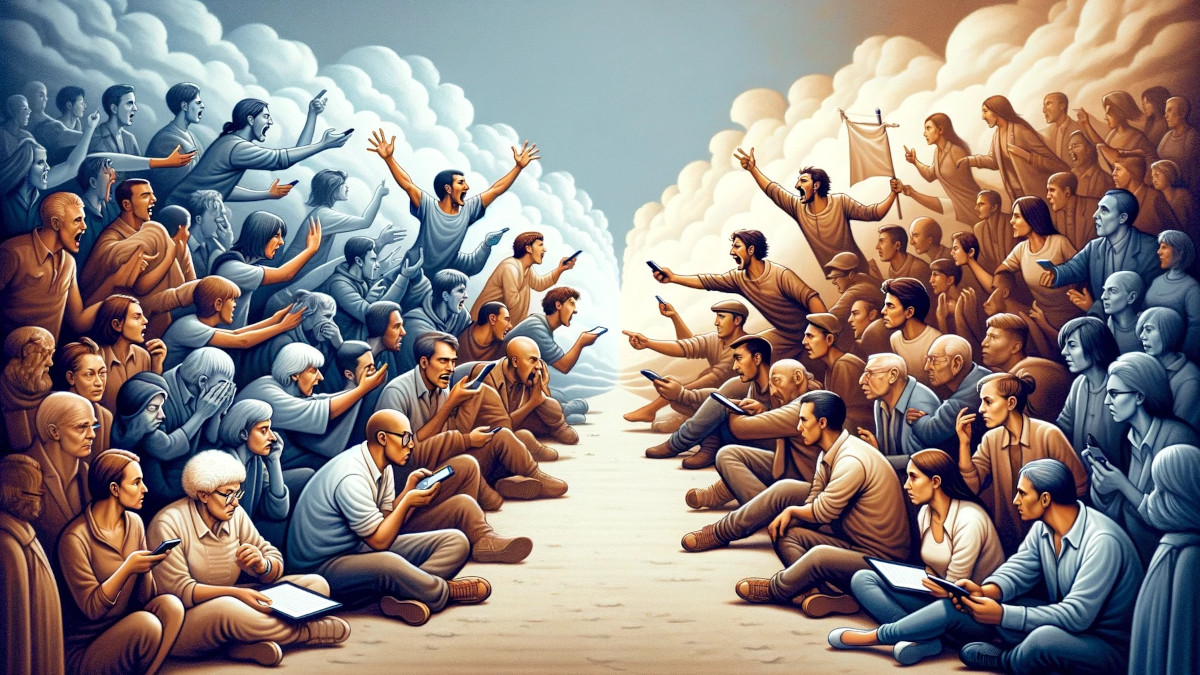
You are being canceled! Cancel culture and accompanying callout culture have emerged in the last couple of years, taking the world by storm. Society is changing from an honor and dignity culture to a victimhood culture. What are these cultures, and how do they behave in an increasingly polarized world?
In The Coddling of the American Mind, Jonathan Haidt and Greg Lukianoff note that an interesting phenomenon emerged over the last decade: A shift from intent to impact.
In the past, it was generally accepted that there had to be an intent for you to be judged and held accountable for the results of your actions. If a person tries to kill you and fails, they will get a harsh penalty because of the intent of attempted murder. If you give them a piece of cake that contains something they are allergic to and it kills them, you have not committed a crime since you were unaware that they have an allergy. You didn’t intend to harm anyone. It is the intent that matters.
In the past, you had to intentionally dislike people of a specific group and wish them harm. Then you were a bigot. However, this has changed. It is not the intent that matters but the impact.
Today, you are seen as a bigot if you say something that someone from a marginalized group can consider offensive. It doesn’t matter that you haven’t realized what the impact would be. It doesn’t change the fact that there was an impact. You said something, and someone else felt offended and diminished. You may not mean any harm, but it doesn’t change the fact that you are seen as the cause of it.
“It is not the intent that matters but the impact.”
A survey conducted by FIRE and YouGov in 2017 analyzed 1,250 college students’ attitudes toward free expression. 58% of students agreed that being part of a campus where they are not exposed to intolerant or offensive ideas is important.
Of course, the question is what students see behind the word “offensive.” 45% of students might avoid interacting with a peer who makes an offensive statement, yet what is offensive to one person is completely acceptable to another one. 48% of students self-censored because they thought other students might judge them, and 30% didn’t speak because they thought others might consider their words offensive.
This is a sort of good news-bad news situation. On the one hand, it is good to see that students are more aware of their impact on others and try to play nice. On the other hand, many things are being unsaid as students would rather play it safe than say anything that could be misinterpreted and taken as offensive.
Moral Cultures
Sociologists Bradley Campbell and Jason Manning describe three types of moral cultures: honor culture, dignity culture, and victimhood culture.
Historically, think before the 20th century in the Western world, and even some cultures today are based on the honor culture. The image of a person is everything, and any offense needs to be dealt with swiftly. Protecting one’s honor and moral integrity is more important than life. But it needs to be done by the person themselves. Complaining to a third party or asking for help is anathema to this type of culture.
The 20th century in the USA and other Western democracies was based on the dignity culture where the value of a person is not dependent on what others think about them. That means no one needs to overreact to any perceived slight or offense. In a dignity culture, people are expected to be mature adults with enough self-control to not overreact to minor annoyances. When it comes to major conflicts, they can rely on the system.
“Honor and dignity cultures are slowly changing into a victimhood culture where people tend to overreact, seeing insults in everything.”
This type of culture is slowly changing into a victimhood culture where people tend to overreact, seeing insults in everything. Moreover, instead of solving these perceived offenses on their own, people hand over the conflict resolution to a third party and create an image of being a victim who is entitled to outside help.
So instead of discussing perceived insults, maybe even unintentional, like confident adults, people ask authority, a boss or police, to solve the issue for them. Often, both sides see themselves as being right and compete over who is a bigger victim in front of the authority. Over time, this leads to the learned inability to resolve any conflict independently. The cancel and callout cultures emerge.
Social media strongly supports the culture of victimhood. Anyone who feels offended can easily find a receptive audience online. An audience that doesn’t have enough insight into the details of a particular case or the motivation of both parties but that is quick to take sides based on one or two sentences from the perceived victim.
Cancel Culture
When students call for canceling a speech by a controversial figure with opinions they don’t share and say the speech would cause them mental, social, and even physical harm, they succumb to various cognitive distortions like labeling, overgeneralizing, and catastrophizing.
Should the fact that someone might be offended by the content be a reason to cancel a university speech or lecture?
“Cancel culture emerged by people succumbing to various cognitive distortions like labeling, overgeneralizing, and catastrophizing.”
Jonathan Haidt and Greg Lukianoff suggest that it depends on what you see as a purpose of education. They point to a comment by Hanna Holborn Gray, the former president of the University of Chicago, “Education should not be intended to make people comfortable; it is meant to make them think.” The moment you start censoring what students learn based on their feelings, you are giving priority to making them comfortable and preventing them from learning to think.
Erika Christakis, a lecturer at the Yale Child Study Center, wrote an email questioning the appropriateness of the university administrators to police what costumes are appropriate to wear on Halloween. The administrators worried that some students might wear inappropriate costumes that could cause hurt or offense in others.
Christakis’s point was that the faculty shouldn’t do that as the students are capable of using common sense themselves, and too much guidance cultivates vulnerability and carries costs to the future. She also quoted her husband saying that “if you don’t like a costume someone is wearing, look away, or tell them you are offended. Talk to each other. Free speech and the ability to tolerate offense are the hallmarks of a free and open society.”
Instead of triggering a conversation as she intended, she triggered a firestorm. Nearly a thousand students raised and demanded her removal from the school, claiming her remarks were racist, offensive, and creating an unsafe environment. Students even threatened Erika and her husband with physical harm.
The unfortunate consequence of events like these is that people get scared to voice their opinions. They can never be sure who will take offense for what reason. Therefore, anything that can be even a bit controversial is better to be unsaid. Is this really the world people want to live in? Everyone scared and fragile, unable to cope with the slightest sign of discomfort? All that was needed was to take the original email and look at it with a charitable interpretation. That would lead to an open conversation on its merits, not to a witch hunt.
Callout Culture
The emergence of callout culture comes from the combination of focusing on microaggressions and a divided society. Once you identify a specific group as an enemy and assume that even small comments, gestures, and behaviors are meant to hurt and cause offense, it is easy to speak up and publicly call out such behavior. You feel offended, and by calling out the offender publicly, you are getting points within your community and becoming a hero, while the offender is seen as a villain regardless of whether they meant any harm.
In fact, in the callout culture, you don’t get any social points for taking the matter private. If you would privately suggest to the offender that their language can be offensive and they would thank you and stop doing it, you wouldn’t get any plus points with your community. It could even be taken against you.
When you publicly call out the person, your in-group rewards you with heightened status. By shaming others, you look like a hero to those with the same politics or agenda. The net outcome is a frightful, divided society where fear and self-censorship rule, and human decency is replaced by shaming and terror.
“In the callout culture, you don’t get any social points for privately suggesting to the offender that their language can be offensive. When you publicly call out the person, your in-group rewards you with heightened status. By shaming others, you look like a hero to those with the same politics or agenda.”
Especially on social media, one has to be extremely careful what they write. It is not about being right or wrong. It is not about truths or lies. Anything can be seen by someone as offensive and can be called out, and there is always an eager audience who will step in and escalate whatever perceived offense out of proportion. Social media amplifies the worst in us and turns even decent people into a hateful mob. This is especially true when you can hide behind the veil of anonymity as you often can on internet forums.
The problem with callout culture is that violence suddenly becomes an option. If someone feels threatened by the opinions of others, they think they can use physical violence to shut them up. What’s worse, they consider it an act of self-defense. In this binary thinking, if you would then oppose their violence, you would be immediately labeled to belong to the same group as the person whose speech offended them and, therefore, an enemy.
Charitable Interpretation
What to do about it? Consider charitable interpretation. The principle of charity or charitable interpretation requires the listener to interpret the speaker’s statement in the most rational way possible. You should always assume that the speaker means well and see their speech in such a light.
“The principle of charity requires the listener to interpret the speaker’s statement in the most rational way possible. You should always assume that the speaker means well.”
It is the exact opposite of what many people do when they automatically assume that what is being said is meant to demean or hurt them. That is rarely the case. Most people don’t realize that their words can be interpreted as offensive. Even the ancient Stoics two thousand years ago knew that it is not the words themselves that are hurtful. It is our interpretation of those words that create the problem.
If you follow the principle of charity, you won’t be offended. You may even point out to the speaker that some people may take offense. Instead of creating a vengeful mob, you can help make the world a better place.
What’s your take on the morality of the Western world in the 21st century? Do you believe the movement of cancel and callout culture has made the world better? Do you think it is helping those from marginalized groups? Do you think it is helping our children to become better adults?
Photo: Generated by DALL-E




Leave a Reply