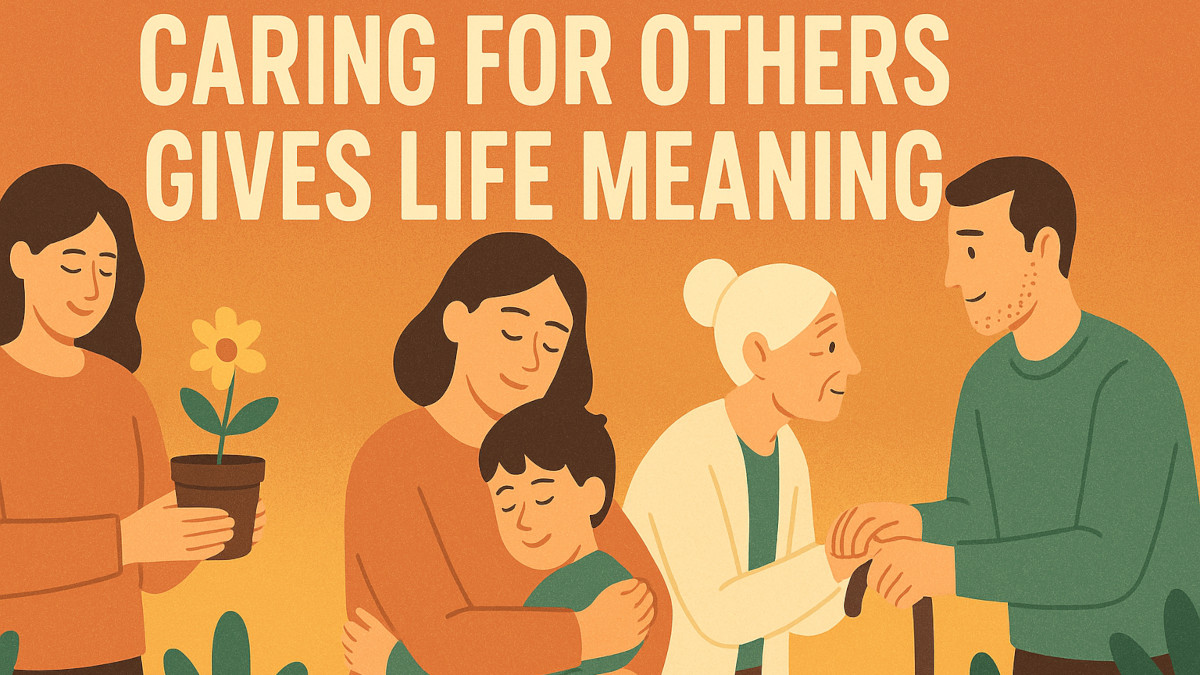
Caring for something or someone gives life meaning.
It is so much more powerful than just wanting something or running towards something to win and be successful. The responsibility, even duty, of deeply caring about what we do helps us to live a good life.
If you ask yourself, “What would happen if I disappear tomorrow?” and the answer is “nothing,” your life probably doesn’t have much meaning. If the answer is “no one would care about my kids,” or even “no one would water my flowers,” you know that you are needed and your life has meaning. If you were to disappear, it would have a profoundly negative impact on the world.
Caring for someone or something requires commitment and sacrifices. That’s the price we pay for living a good life that has a purpose.
The alternative is to care about nothing and no one, only ourselves. No need for commitment. No need for sacrifice. We can jump from one thing to another. Leaving jobs and people when we get bored. Trying to shape the world to our needs, yet failing most of the time. Preferring short-term pleasures over long-term meaning. Striving for more and, as a consequence, living empty lives.
Wasting Our Potential Vs. Committing To Something
Yet we are so focused on not wasting our potential that we don’t want to commit to anything that would prevent us from achieving all we can be.
Curiously enough, by doing this, we often achieve the exact opposite of what we truly want. We may seem successful, but inside, we are empty because we feel that the outward success we’ve achieved is not what we truly want deep down.
You can observe this phenomenon when looking at famous individuals or the extremely wealthy. They are successful when their fame or accumulated wealth is a measure of success. Yet, they are often depressed, prone to alcohol and drug abuse, and generally don’t seem to be particularly content with their lives.
We Find Excuses Not To Commit
When we think about who we are, we usually focus on what we have accomplished. We consider the things we did or that happened to us. We forget that we are also being formed by things we didn’t do and things that didn’t happen to us.
You can say that you are a trusting person because others always help you. You forget that, at the same time, you are not paranoid because others never betrayed you. Every time we make a decision to do something, we are, by default, also making a decision not to do something else. This combination is what makes us who we are. Sometimes we do something because we truly want to do it. Sometimes we do it, so we don’t need to do something else. Often, we are afraid to commit, and so we instead invent reasons and activities to focus on as a justification for why we can’t commit.
I love getting new experiences. I travel to countries and places I’ve never been to before. I enjoy trying new foods, observing different cultures, and engaging in new activities. The more, the better. But why? I have to ask myself, “What’s the point?” And the answer is rather depressing. There is no special reason. I do these things because I enjoy them, and I can. There is no higher purpose. There is no meaning. There is no finish line. When I die, I will stop doing all these things, and no one will notice.
By doing all these things, I have an excuse not to commit to a single thing to become really great at it, or to a single community, or a single person to have a real impact on the lives of others. I suppose I can claim, and I do, that it’s all for self-development. By traveling and trying new things, I become a better person. Maybe.
Duty, Commitment, And Social Cohesion
When examining ancient philosophies and religions, they may seem somewhat similar to early self-help training, but in reality, although they promoted certain virtues that we should all strive to live by, they were not primarily about self-development. They were primarily concerned with duty towards others, justice, sacrifice, and living good lives to be the best human beings they could be. Not for our own benefit, but for the benefit of everyone.
For thousands of years, humans realized their potential by being part of their tribe and contributing to its well-being. That was the goal of life. This changed with the Industrial Revolution. The goal shifted towards more individual achievements. Life has become about accumulating wealth and then using that wealth for consumption. Modern consumer capitalism emerged, and we stopped prioritizing the greater good. We started focusing on ourselves, our wealth, our fame, and our self-realization.
Oscar Wilde famously said, “The only way to get rid of temptation is to yield to it… I can resist everything but temptation.”
Most of us follow Wilde’s words. We focus on ourselves, give in to temptations, and each day make the world a worse place by forgetting about our duty and purpose. We don’t care about anything but our own enjoyment. We want to be happy.
Moderation Is The First Step Towards Caring About Others
Moderation and so-called delaying gratification lead to a better life, and it is a path towards caring about others and making the world a better place.
We may think that delaying gratification is not the best strategy in a world where survival of the fittest prevails.
If you meet a bunch of friends and have a chocolate bar or a bottle of wine, you may want to share them. And share with them equally. It may not pay off immediately. It may not pay off ever. But it also may. Reciprocity is ultimately important for social cohesion. You would definitely want your children to share. It is the right thing to do. Asking yourself, “What’s in it for me?” all the time is called opportunism, and it is rarely a good long-term strategy. You may get wealthy, but you will be left alone against the world.
Donald Trump is a prime example of what the consumer society has done to us. Trump is someone who doesn’t believe in defeat and who wants it all. He is a product of a society that wants more and more of everything. And not only is that attitude unsustainable when it comes to natural resources, but it is also dangerous for democracy. If no one ever accepted defeat in democratic elections, democracy wouldn’t work. We would be at constant civil war until a point when a dictator rises and makes it crystal clear who the winners are and who are the losers. Losers are the ones dead, in prison, or quietly serving as ordered without their own independent thought.
We Are Becoming Small Dictators
The implications of wanting more and more are clearly visible in the way we see freedom. A free society would historically be one where people have freedom of choice and can work together without undue pressure or direction from a sovereign or dictator.
However, for many people, freedom became not about their place in society but simply about themselves. They don’t care about others at all. They want their unlimited ability to choose, and how their choices impact others is irrelevant to them.
The moment you start caring about others, you introduce restrictions to what you can choose and what you can do yourself.
And so our Western democracy is slowly turning from social democracy to individual dictatorships. Each of us is our own dictator, and we would fight for our right to choose regardless of the consequences for others.
And so people fight against vaccinations and other activities pushed by the democratic governments that promote the common good. We don’t care about the common good anymore. We care only about ourselves. About getting our due and about getting it now.
What To Do About It?
We may still believe that everyone is responsible for their own fortunes, but we need to acknowledge that this is not entirely true. There are limits to what individuals can do. The environment and systems in place play an important role. We need to look at concepts of equity and become more other-focused. Selfishness needs to give way to solidarity. We should stop trying to have it all and rather ensure that everyone has enough.
To focus on the social ties that matter, you can tap into the power of rituals. Since ancient times, humans have used rituals to strengthen the bonds within their groups. You may find various celebrations and collective gatherings silly or a necessary evil, but they play an important role. Consider small villages where visits to church, weddings, funerals, birthdays, or seasonal celebrations provide an opportunity to meet with neighbors and foster community. You will never get this on social media. Rituals in public spaces help foster social cohesion, guiding our interactions and making them meaningful, even when we are not necessarily friends.
You then need some hardship to enjoy comfort, and you also need some constraints to enjoy freedom. Without any limits, without any rules, freedom turns into anarchy, and you won’t really enjoy it. It won’t feel like freedom. It will be paralyzing. It will make you feel anxious. It may even become terrifying.
When you become focused on others, you will eventually see a purpose to your life. You may not have the latest gadget, and you may experience hardship from time to time, but you will feel better about your life. Your life will have meaning. You will make the world a better place.
Photo: Generated with Dall-E




Leave a Reply