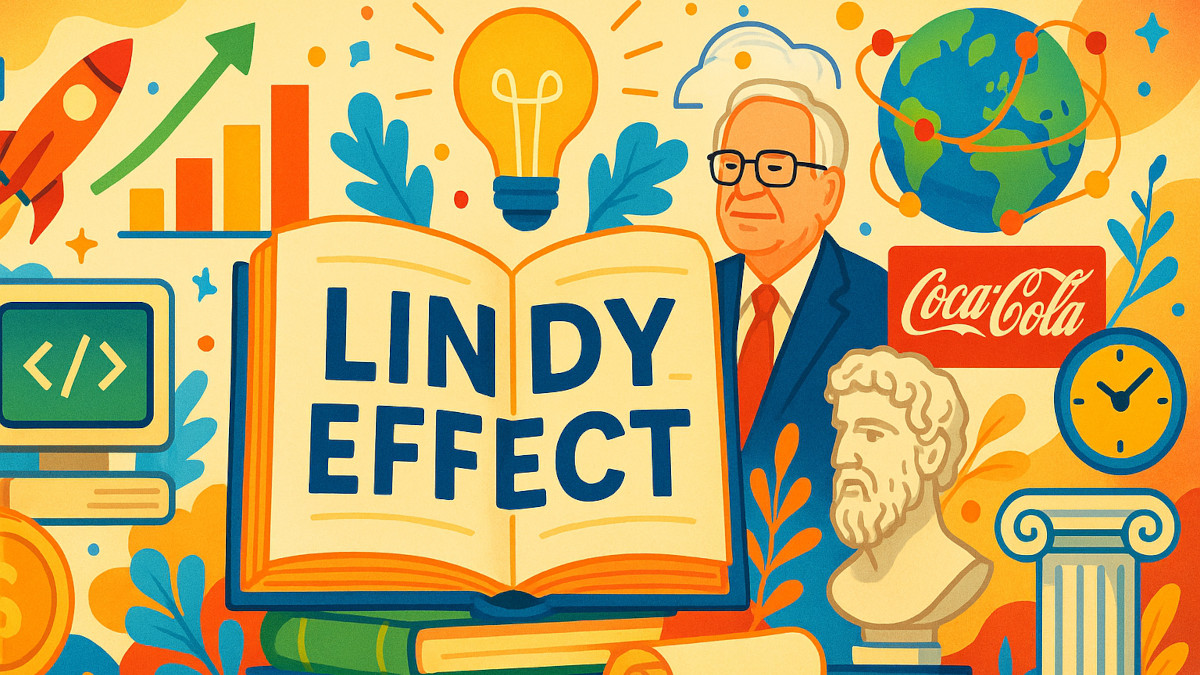
In a world obsessed with the latest trends, breakthrough technologies, and revolutionary ideas, a powerful counterintuitive principle exists that suggests an opposite approach might yield better results. This principle, known as the Lindy Effect, posits that the longer something has survived, the longer it is likely to continue surviving. Far from being a dusty academic concept, the Lindy Effect offers profound insights into how we should approach investing, decision-making, learning, and life itself.
What Is the Lindy Effect?
Lindy is not the name of a famous philosopher. Rather, it is the name of a Deli in New York. It was those who gathered there fifty years ago who came to a startling realization. Broadway shows that had been around for a couple of months had a couple more months to live. Shows that were around for centuries had centuries to live. Thus, the heuristic was born and got the name Lindy Effect.
The Lindy Effect states that the future life expectancy of a nonperishable item is proportional to its current age.
It answers the question of who is the best judge of quality and worthiness? Time is. Things that have survived for a long time are most likely to continue surviving in the future. They are often what Nassim Taleb calls “antifragile.” They get stronger with time and adversity.
As Nassim Nicholas Taleb says in Skin in the Game, “That which is ‘Lindy’ is what ages in reverse, i.e., its life expectancy lengthens with time, conditional on survival.” Things that have already proven their resilience over time are more likely to continue surviving.
Only the nonperishable is subject to the Lindy Effect. Food, or even the physical copy of a book, is not subject to it. Ideas, the content of the books, technologies, or systems that are not perishable, are subjected to this effect.
How the Lindy Effect Works
The mechanism behind the Lindy Effect is rooted in the concept of “revealed preference” and stress-testing over time. When something survives for an extended period, it demonstrates several critical qualities:
- Antifragility and Adaptability: Long-surviving entities have proven their ability to withstand various stresses, challenges, and environmental changes. They’ve been tested by time and emerged stronger or at least intact.
- Universal Appeal: Ideas, technologies, or institutions that persist across generations often address fundamental human needs or timeless problems. They possess qualities that transcend temporary trends or cultural fads.
- Network Effects and Reinforcement: The longer something exists, the more embedded it becomes in existing systems. Books that have been read for decades influence other writers and thinkers, creating reinforcing cycles that increase their staying power.
- Selection Pressure: Time acts as a brutal filter. Weak ideas, poorly designed technologies, or unsustainable business models are eliminated, leaving behind only the most robust survivors.
- Survival of the Fittest: It is critical not only that the books of the ancients are still around and have been filtered by Lindy, but also that the populations who read them have survived. That further validates the ideas written in the books, which actually work and allow society to survive.
Famous Practitioners and Examples
Several successful individuals and institutions have an intuitive understanding of the Lindy Effect, even if they don’t explicitly reference it by name.
Warren Buffett and Value Investing
Perhaps no investor embodies the Lindy Effect principle more than Warren Buffett. His investment philosophy centers on identifying companies with enduring competitive advantages that have already proven their resilience over decades.
In 1988, Buffett began buying The Coca-Cola Company stock, eventually purchasing more than $1 billion worth of stock, back then 6.2% of the company. This investment exemplifies Lindy thinking: Coca-Cola, founded in 1892, had already survived for nearly a century when Buffett invested, weathering economic depressions, world wars, and countless changing consumer trends. Berkshire Hathaway has held the stock since 1988, underscoring its appeal to long-term investors.
Warren Buffett exemplifies the practical application of considering the Lindy Effect for value investors, as it can provide valuable insights into a company’s longevity and potential future performance. His approach of buying great companies at fair prices rather than mediocre companies at cheap prices reflects an intuitive understanding that businesses with long track records of success are more likely to continue succeeding.
Technology and Innovation
While technology might seem to contradict the Lindy Effect due to rapid obsolescence, certain foundational technologies demonstrate remarkable persistence. The wheel, writing systems, and basic mathematical principles have endured for millennia and remain relevant. Even in modern computing, programming languages like C (created in 1972) and UNIX-based systems continue to underpin much of our digital infrastructure.
The internet protocol TCP/IP, developed in the 1970s, remains the backbone of global internet communications. These examples show that even in rapidly evolving fields, Lindy-compliant technologies often provide the foundation upon which newer innovations are built.
Books and Information Consumption
I would suggest that you should pay particular attention to the Lindy Effect in information consumption. I’m an avid reader and read more than fifty books a year. I also read a lot of articles and scientific papers.
Only relatively recently have I realized that over the last several years, I have read more and more “classics.” I still read the most recent research in a variety of fields, but I keep returning to the wisdom of the ancients as represented by my interest in Stoicism. The works of Marcus Aurelius, Epictetus, or Seneca have survived for two millennia, and therefore, chances are good that they will survive for at least two more.
Outside of philosophy books, Homer’s Iliad and Odyssey, as well as more modern books like 1984 by George Orwell (written in 1949) and Brave New World by Aldous Huxley (written in 1931), have survived for 70 and 90 years, respectively, and remain relevant today, just as they were when they were written. Chances are, they will be relevant still at the end of this century.
Real-World Applications and Examples
The Lindy Effect manifests across numerous domains:
- Literature and Ideas: Classic works, such as Shakespeare’s plays, Plato’s philosophy, and the Bible, have endured for centuries and continue to shape contemporary thought. Their longevity suggests they will likely remain relevant for centuries to come.
- Business Models: Companies like JPMorgan Chase (founded in 1799), The New York Times (1851), and Procter & Gamble (1837) have demonstrated remarkable resilience across multiple economic cycles, technological disruptions, and social changes.
- Cultural Practices: Traditional practices like meditation, storytelling, and family meal traditions have persisted across cultures and millennia, suggesting their continued relevance to human wellbeing.
- Financial Instruments: Basic financial concepts, such as compound interest, risk diversification, and long-term investing, have proven their worth across centuries of market cycles.
The Advantages of Lindy Thinking
Adopting a Lindy-informed perspective offers several significant benefits:
- Increased Predictability And Risk Reduction: By favoring time-tested approaches, individuals and organizations can avoid the high failure rates associated with unproven innovations. Most new businesses, technologies, and ideas fail quickly, while established ones have already survived the initial high-risk period.
- Signal of Quality: The Lindy Effect provides a useful heuristic for decision-making in uncertain environments. When faced with choices between novel and established options, Lindy thinking suggests giving extra weight to proven alternatives.
- Intellectual Humility: Understanding the Lindy Effect cultivates humility about human ability to predict what will succeed. It suggests that collective human experience, as expressed through survival over time, often contains wisdom that individual analysis might miss.
- Resource Allocation: Organizations can allocate resources more effectively by recognizing that established systems, while perhaps less exciting than new innovations, often provide more reliable foundations for building upon.
- Learning Efficiency: Students and professionals can focus their limited time on learning principles, skills, and knowledge that have demonstrated lasting value rather than chasing every new trend or technique.
The Limitations and Criticisms
Despite its usefulness, the Lindy Effect has important limitations that practitioners must acknowledge:
- Innovation Paralysis: Excessive focus on time-tested approaches can lead to stagnation and missed opportunities. Revolutionary innovations, by definition, can’t demonstrate Lindy properties. Companies or individuals who rigidly adhere to Lindy thinking might miss breakthrough technologies or paradigm shifts.
- Survivorship Bias: The Lindy Effect can reflect survivorship bias. We only observe things that have survived, not the potentially superior alternatives that were eliminated by chance, politics, or other non-merit factors. Sometimes inferior solutions persist simply because they achieved early adoption or network effects.
- Context Dependency: What survives in one context may not be optimal for another. Technologies or practices that worked well in past environments might be poorly suited to contemporary challenges. For example, certain traditional business practices might be inefficient in modern digital environments. Or, medical procedures that worked for hundreds of years in the Middle Ages may not be suitable for modern medicine.
- Speed of Change: In rapidly evolving fields, the pace of change might be so fast that historical survival becomes less predictive of future success. The half-life of relevance in some technological domains has shortened dramatically.
- False Security: The Lindy Effect can create overconfidence in established systems, leading to complacency and failure to adapt when genuine disruption occurs. Even Lindy-compliant entities can face extinction if they fail to evolve appropriately.
Balancing Lindy Wisdom with Innovation
The key to effectively using the Lindy Effect lies not in rigid adherence but in balanced application and understanding of probabilities and statistics. Successful individuals and organizations often place most resources in time-tested, low-risk approaches while dedicating a smaller portion to high-potential, high-risk innovations.
This may involve building investment portfolios primarily around established companies with proven track records, while allocating a small percentage to emerging opportunities. In personal development, it may involve mastering fundamental skills that have proven valuable across generations, while also staying curious about new developments in your field.
The Lindy Effect also serves as a useful filter for information consumption. In an age of information overload, prioritizing books, ideas, and principles that have demonstrated staying power can provide more valuable insights than constantly chasing the latest trends or viral content.
Putting It All Together
The Lindy Effect offers a powerful lens for understanding resilience, making decisions, and navigating an uncertain world. By recognizing that time itself acts as a form of validation, we can make more informed choices about where to invest our time, energy, and resources.
However, like any mental model, the Lindy Effect works best when applied thoughtfully rather than mechanically. The goal is not to reject all innovation or cling blindly to tradition, but to develop a more nuanced appreciation for the wisdom embedded in things that have already proven their worth over time.
Whether applied to investing, learning, business strategy, or personal development, Lindy thinking can help us build on solid foundations while remaining open to genuine innovation.
The paradox of the Lindy Effect is that by looking backward to understand what has survived, we might be looking forward to what will continue to survive. In an uncertain world, that perspective offers both practical wisdom and a measure of comfort that some things, at least, are built to last.
Photo: Generated with Dall-E





Leave a Reply