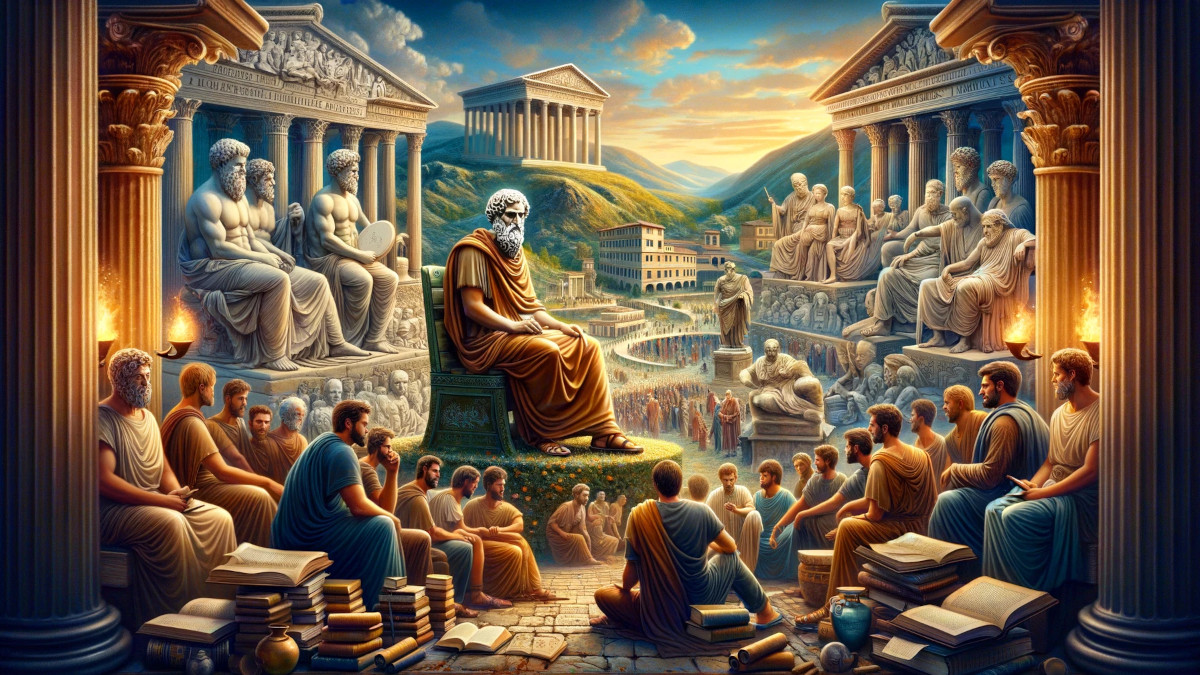
Stoicism is a school of Greek philosophy founded by Zeno of Citium in Athens in the 3rd century BC. It derives its roots from Socrates and Cynicism. It is a philosophy of personal ethics that is very practical and teaches that the path to eudaimonia (or happiness) is based on accepting one’s fate, not allowing oneself to be controlled by emotions like pleasure or pain, and living in accordance with what nature intended.
Stoicism takes its name from Stoa Poikile (painted porch), a location in Athens where Zeno of Citium would perform his teachings. There is very little written from the Greek era of Stoicism. Most of what we can read today is from the time of the Roman Empire in the later period with philosophers like Epictetus or Seneca. And, of course, Marcus Aurelius, one of the greatest Roman emperors, whose Meditations are a worthwhile reading even today.
Early Stoicism was heavily influenced by Socrates (470-399 BC) through his students Antisthenes and Plato. It was furthermore impacted by the Cynic School as Zeno of Citium was a student of Crates (365-285 BC).
The time of the glory of Stoicism is usually divided into three periods:
- The Early Stoa started with Zeno of Citium in Greece and included such philosophers as Cleanthes or Chrysippus.
- The Middle Stoa is represented by Panaetius and Posidonius.
- The Late Stoa started with Seneca in the Roman Empire and included philosophers like Gaius Musonius Rufus, Epictetus, and the Roman Emperor Marcus Aurelius.
Stoicism And Noteworthy Stoics
Zeno of Citium (332–262 BC) was a merchant from Cyprus who eventually ended up in Athens and became a student of Crates the Cynic. After some time, he made the next step and created his school of thought, Stoicism.
Cleanthes of Assos (330–232 BC) was a day laborer in Athens who took over after Zeno’s death and became the second head of the Stoic School. He was instrumental in defining the differences between Stoicism and Asceticism as promoted by Cynics.
Chrysippus of Soli (280–204 BC) was the third head of the Stoic School and one of its most prominent figures. Even though he is often compared to Aristotle for his focus on logic, most of his work, like most of the other early Stoics’ work, is lost. He reinforced the system on which Stoicism is based, relying on logic, ethics, and physics.
Cicero (106-43 BC) is another figure worth mentioning. Even though he wasn’t a Stoic, he was a student of Posidonius and helped spread Stoicism to Rome.
Most of the writings we have today come from the Late Stoa and the time of the Roman Empire.
Stoicism arrived in Rome during the upheaval of the transition from the late Republic to the Empire. Cato the Younger (94–46 BC) modeled behavior for later Stoics through his opposition to Julius Caesar.
Lucius Annaeus Seneca (4 BC–65 AD) was born in Cordoba, which was then a town in Roman Spain. He was a tutor to Emperor Nero and has left us with the most extensive collection of writings of any Stoic.
Gaius Musonius Rufus (1st century AD), sometimes compared to Socrates, was another tutor during Nero’s reign. Among his pupils was Epictetus.
Epictetus (55–135 AD) was born in Hierapolis in present-day Turkey. Epictetus was not his real name; it means “acquired,” which means he was a slave. He didn’t author any works on his own, but luckily for us, his student Arrian wrote down his teachings. Epictetus studied philosophy under Musonius Rufus. His most notable contribution revolves around accepting our fate and focusing on what is under our control. His teachings show that we control only our thoughts, desires, and actions.
Marcus Aurelius (121–180 AD), one of the greatest Roman Emperors, was a devout Stoic, even though not a philosopher. He was heavily influenced by Epictetus and not only lived as a proper Stoic but also wrote down a body of work that can be read today. Marcus Aurelius was born into a noble family. His father, Annius Verus, held a high office in Rome. He was later adopted by Antoninus Pius, who afterward became emperor. Since Antoninus had no direct descendants, Marcus became next in line to become an emperor together with Lucius Verus, another adopted son of Antoninus. Marcus Aurelius became not only an emperor but also one of the most well-known practicing Stoics.
Opposing schools
Stoicism had a couple of opposing schools of thought in its day, as George Tanner summarizes in Stoicism: A Detailed Breakdown of Stoicism Philosophy and Wisdom from the Greats.
Aristotle’s Peripatetic school believed that the end goal of an ethical life was eudaimonia, or human flourishing, which was very attractive to the Stoics, but had a different way of getting there.
The second school, the Epicureans, believed that pleasure is the aim of ethical life and is sufficient for happiness. This didn’t sit well with the Stoics, who believed that eudaimonia, or a life worth living, couldn’t be achieved by focusing only on pleasures.
Since Zeno was a student of the Cynic School, it stands to reason that this particular school of thought had a rather profound effect on Stoicism. There are a couple of differences. The key difference and the reason why Stoicism is much more attractive to us today is that the Cynics believed in asceticism and refused worldly possessions. They tried to live as simply as possible, and any luxury was seen as a distraction.
The Stoics didn’t have such a hard stance. Even though they also admitted that there is no point in hoarding stuff, they felt that it is acceptable to enjoy luxury as long as it serves its purpose and helps you be virtuous. And, of course, as long as you understand that it is just a thing that can be taken away from you, you won’t be distraught because of it.
For more details on the history of Stoicism and its basic tenets, refer to an excellent essay by Massimo Pigliucci. And if you want to get into more detail, then study some of the major Roman Stoics, like Epictetus, Seneca, and the emperor Marcus Aurelius.
Alternately, subscribe to this blog as I will dive deeper into the Stoics teachings and its relevance in the 21st century in a series of posts over the next few months.
Photo: Generated with ChatGPT/Dall-E





Leave a Reply