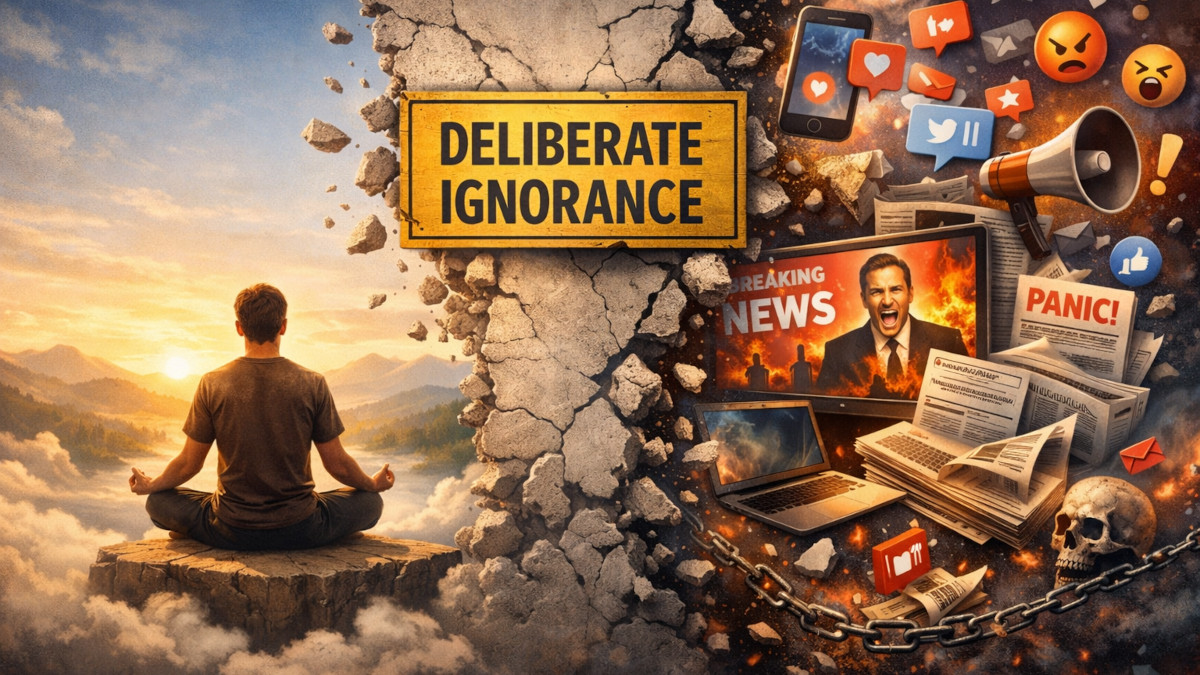
There was a time when ignorance was considered a flaw. Being informed was seen as being responsible. To know more was to be better. Knowledge signaled intelligence and wisdom. But something has changed. Attention merchants came, and with them the notion of deliberate ignorance.
Today, we live in a world where information is far from scarce. It is overwhelming. News cycles bombard us with attention-grabbing headlines, social feeds are endless, and the world has gotten smaller. Before we have a chance to digest one piece of information, ten additional ones are waiting in line.
So we stop digging deep. Headlines are enough. The more we consume, the less we seem to understand.
In such an environment, the smart thing is not to try to keep up with everything, but to restrain ourselves and be very picky about what information we consume. That’s why adopting deliberate ignorance, the conscious decision to ignore what is irrelevant, distracting, or harmful to our thinking, is taking root.
I love the quote by American economist and political scientist Herbert Alexander Simon, “What information consumes is rather obvious: it consumes the attention of its recipients. Hence a wealth of information creates a poverty of attention…”
I’m not trying to suggest you stop reading or stop being informed about what’s going on in the world. On the contrary. I’m a voracious reader, and if anything, I believe you should read more. But be extremely selective about what you read and the types of information you allow your mind to absorb.
In the end, what we consume has a direct impact on who we become. If you eat unhealthy food, you become unhealthy. If you consume unhealthy information, your mind becomes unhealthy too.
The Rise of the Attention Merchants
To understand deliberate ignorance, we must first understand the system that led to the need for such a practice.
Modern economies and digital platforms operate on a simple premise: attention is currency. If they can grab your attention, they can also grab your money. The longer you stay, the more valuable you are. Every click, scroll, and pause is measured, analyzed, optimized, and sold to advertisers. Your attention is being monetized. You are being monetized.
The same with television news. The goal is not to keep you informed but to keep you entertained. How much actual information can be put into a minute-long news segment? Not much. No context. No opposing perspectives. No deep dives. Just attention-grabbing headlines and a couple of viral and ideally rage or fear-inducing sentences that will keep you engaged and glued to the screen.
The Illusion of Being Informed
If you think that by watching TV news, reading headlines on social media, and following the comment sections under articles, you are getting information, you are wrong. You are being used. You believe that you are informed, but in reality, you are disinformed. You are not aware of what’s going on in the world. You just believe you are aware.
At best, you learn what happened. But you never learn why it happened. You never learn what it means. You never get a chance to think about it with a critical mindset. You just accept the information as it is being served. It’s comfortable. No critical thinking happens.
While we tell ourselves that we are informed, we are missing context. We get fragmented, often emotionally charged, information that is outdated before we can even express our outrage. Instead of building awareness and understanding of the world, we are creating impressions.
Our brains evolved in information poor environment and are not ready for the information overload. We need to see patterns, things need to fit together, and we need to see meaning. If we don’t get that, we misinterpret what we are being told and react emotionally, often with quick, often heavily biased judgment.
The Cost of Constant Consumption
The consequences of this environment are profound. When we are constantly distracted, deep thinking becomes rare. When every moment is filled with input, there is no space for reflection. When emotions are continually triggered, calm and critical reasoning becomes difficult.
Given enough time, we become constantly distracted and can’t keep focus on anything. This means we lose the ability to actually learn. A shallow understanding is all we are capable of. With most of the information grabbing our attention being focused on triggering our emotions and eliciting rage for bigger engagement, we are becoming more anxious and depressed.
The tragedy is not that we lack information, it is that we lack the ability to process it meaningfully.
What Is Deliberate Ignorance?
Deliberate ignorance is not the rejection of knowledge. It is the rejection of noise. It is the recognition that not all information is equal, and that some information actively harms our ability to think.
To practice deliberate ignorance, learn to filter information sources aggressively. I don’t mean creating an informational bubble or taking information from just one source. That is exactly the wrong approach. Go for a wide range of high-quality sources. Hint: you won’t find these in social media comment sections.
Then, consume information very selectively. Do you really need to know about every war, murder, and celebrity scandal in the world? The vast majority of that type of information is just noise. It doesn’t matter. It doesn’t impact you in any way. It doesn’t make you wiser and better.
It is the understanding that attention is finite, and that every piece of information you allow in occupies space that could be used for something better. It’s called opportunity cost.
When you spend your time consuming low-quality content, you can’t spend the same time on something that could truly change your life for the better. You could read a book that brings you real wisdom. For that, I suggest considering the Lindy effect and picking up a book that has lasted centuries, as its wisdom will most likely endure for centuries to come. You could do some deep work and make the world a better place. For any meaningful work to be done, you need long segments of uninterrupted time. You could improve relationships with those in your life that matter.
By ignoring what does not matter, you create space for what does.
The Emotional Economy of Information
Attention merchants do not just compete for your attention. They compete for your emotions. They serve you content that provokes anger, fear, or outrage as it spreads faster. It is more likely to be shared, discussed, and remembered.
Fake news is better than real news if it grabs your attention and makes you angry, so you spread it to others.
By being constantly exposed to emotionally charged content, your perception of reality morphs. The world begins to feel more chaotic, more hostile, and more urgent than it actually is.
In that kind of world, deliberate ignorance is an important form of self-defense. By choosing not to engage with every provocation, you protect your mental state.
“But what if something really important happens and I won’t know about it?” I hear you say. Fear of missing out (FOMO) is often very powerful. And it is completely unfounded. If something is truly important, that information will get to you one way or another.
One of my friends keeps watching the TV news because she is afraid that the war in Ukraine will also spread to the rest of Europe. She needs to know about it so she is ready. But think about it. How likely is it that the war spreads, no one tells her, and one day, going to work, she encounters a Russian tank? Not likely. She could save herself a lot of anxiety by simply ignoring that type of news. If the war comes, she will learn.
The challenge is not missing important information, but rather distinguishing between what is urgent and what is important.
The Discipline of Selective Attention
Deliberate ignorance requires a sort of inverted thinking. Instead of asking, “What should I pay attention to?” you begin by asking, “What can I safely ignore?” It acknowledges that the default state of the modern world is noise that needs to be filtered out.
It is important to distinguish deliberate ignorance from apathy. Ignoring everything is not a virtue. Ignoring what matters is dangerous.
As practical steps, avoid platforms designed for endless scrolling, as they, by design, serve up viral noise. Set clear boundaries on the time spent on information seeking and consumption. Learn to dive deeper into the information you consume. Instead of scrolling through headlines, learn deep details on one particular topic. It is going to be significantly more rewarding.
Putting It All Together
In a world of infinite information, intelligence is no longer defined by how much you know. It is defined by what you choose to focus on and what you choose to ignore. The smartest individuals are not those who consume the most, but those who filter the best.
Deliberate ignorance is then a way to do it. It is a recognition that your attention is valuable, and that how you spend it shapes your life.
In the age of attention merchants, the greatest act of control is not to consume more, but to choose less.
Because in the end, the quality of your life is determined not by the amount of information you take in, but by the clarity of thought you are able to sustain.
Photo: Generated with Dall-E




Leave a Reply